







Paramedic Program Overview
Earn your Paramedic Technology Certificate
Seminole State's Paramedic Technology College Certificate Program
- Trains students to be a Paramedic.
- The second level of EMS training
- Paramedics may perform advanced life-support (ALS) procedures - the treatment of life-threatening emergencies through the use of specific techniques - as identified by the U.S. Department of Transportation, which must be performed under the supervision of a licensed physician.
- Qualifies students to complete the State of Florida Paramedic certification examination administered by the Florida Department of Health, Division of Medical Quality Assurance.
“To prepare competent entry-level Paramedics in the cognitive (knowledge), psychomotor (skills), and affective (behavior) learning domains with or without exit points at the Advanced Emergency Medical Technician and/or Emergency Medical Technician, and/or Emergency Medical Responder levels.”
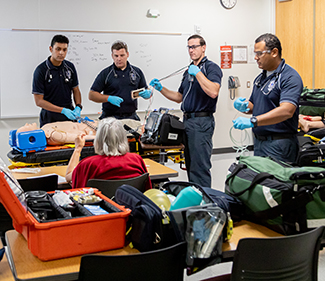
Paramedic Program Accreditation
- Accredited by the Commission on Accreditation of Allied Health Education Programs (CAAHEP).
- CAAHEP accredits the program upon the recommendation of the Committee on Accreditation of Educational Programs for EMS Professions' (CoAEMSP).
State of Florida Approved Program
- Approved by the Florida Department of Health, Bureau of Emergency Medical Services.
- Curriculum adheres to the 2009-U.S. Department of Transportation (DOT) Emergency Medical Technician-Paramedic Education Standards.
Paramedic Program Details
Seminole State's Paramedic Technology Technical Certificate program is designed to prepare students as paramedics.
- Approved by the Department of Health, Office of Emergency Medical Services;
- Accredited by CAAHEP (Commission on Accreditation of Allied Health Education Programs) upon the recommendation of the Committee on Accreditation of Educational Programs for the Emergency Medical Services Professions (CoAEMSP).
- Curriculum adheres to the 2009 U.S. Department of Transportation (DOT) Emergency Medical Technician-Paramedic Education Standards.
- Curriculum content includes, but is not limited to, the six divisions of the DOT Curriculum: pre-hospital environment, preparatory, trauma, medical, OB/GYN/neonatal, and behavioral emergencies.
Paramedic Profession and Seminole State's Program
The paramedic provides emergency care to acutely ill or injured patients in primarily the pre-hospital setting under a physician's direction.
- Reinforcement of basic skills in English, mathematics and science appropriate for the job preparatory programs occurs through vocational classroom instruction and applied laboratory procedures or practice.
- The paramedic performs Basic Life Support (BLS), and Advanced Life Support (ALS) procedures. ALS procedures include venipuncture and initiation of intravenous fluids, administration of medications, interpretation of electrocardiograms, defibrillation and endotracheal intubation.
- All of the advanced life support skills are performed under the direct or indirect supervision of a physician to prepare competent entry-level paramedics in the cognitive (knowledge), psychomotor (skills) and affective (behavior) learning domains with or without exit points at the Advanced Emergency Medical Technician and/or Emergency Medical Technician, and/or Emergency Medical Responder levels.
Supplemental Program Information
- Technical Standards Worksheet
- Paramedic Brochure
- Paramedic Technology Technical Certificate catalog webpage
Paramedic Professional Opportunities
- Private ambulance company
- Fire rescue units
- Hospital emergency departments
- Industrial company
- Cardiac catheterization units
The Paramedic Program Student Handbook is available to download and print.
The Paramedic Program Preceptor Training is available to download and print.
- Preceptor Training PowerPoint version
- Preceptor Training MS Word version (will be posted shortly).
Paramedic Program Outcomes CAAHEP Accredited Paramedic Programs and CoAEMSP Letter of Review (LoR) Programs track and report outcome measures annually to the Committee on Accreditation for the Emergency Medical Services Professions (CoAEMSP).
The most current CoAEMSP Annual Report was for the calendar year 2024.
- The most recent success rate for the National Registry of EMT Paramedic Cognitive exam was 79.1%.
- The most recent positive placement rate for graduates was 100 %. Positive placement is defined by the CoAEMSP as ‘Employed full or part-time in a related field and/or continuing his/her education and/or serving in the military’. Positive placement is measured at completion of the program.
- The most recent retention rate was 94 %.
Paramedic Program Outcomes
Graduation Rate
The on-time graduation rate for students admitted to the program are listed below.
| Calendar Year | Graduation Rate |
|---|---|
| 2020 | 100% |
| 2021 | 80.8% |
| 2022 | 97.6% |
| 2023 | 92.1% |
| 2024 | 94% |
Pass Rates for NREMT
The NREMT pass rates below are for first attempt only.
| Calendar Year | Pass Rate |
|---|---|
| 2020 | 90.4% |
| 2021 | 73.2% |
| 2022 | 80.0% |
| 2023 | 87% |
| 2024 | 79.1% |
Positive Placement Rate
The positive placement rate, as defined by CAAHEP based on the graduates of the paramedic program who are reporting working in either a full-time or part-time position as a paramedic within 12 months of graduation, continuing their education, or serving in the military; are listed below.
| Calendar Year | Job Placement |
|---|---|
| 2020 | 100% |
| 2021 | 100% |
| 2022 | 100% |
| 2023 | 100% |
| 2024 | 100% |
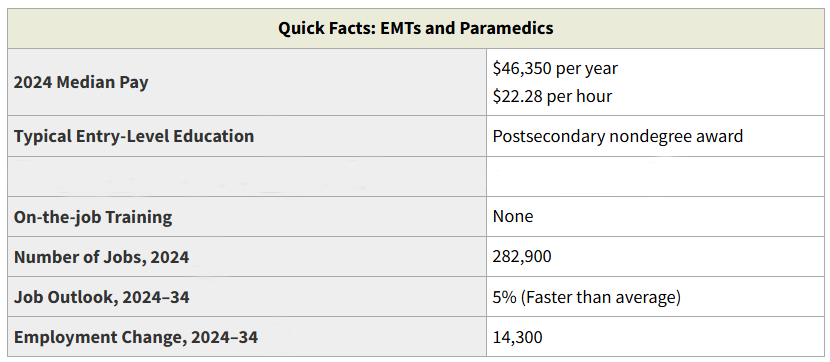
Paramedics Median Pay
U.S. Bureau of Labor Statistics's Occupational Outlook Handbook's Information
for Paramedics Median Pay: